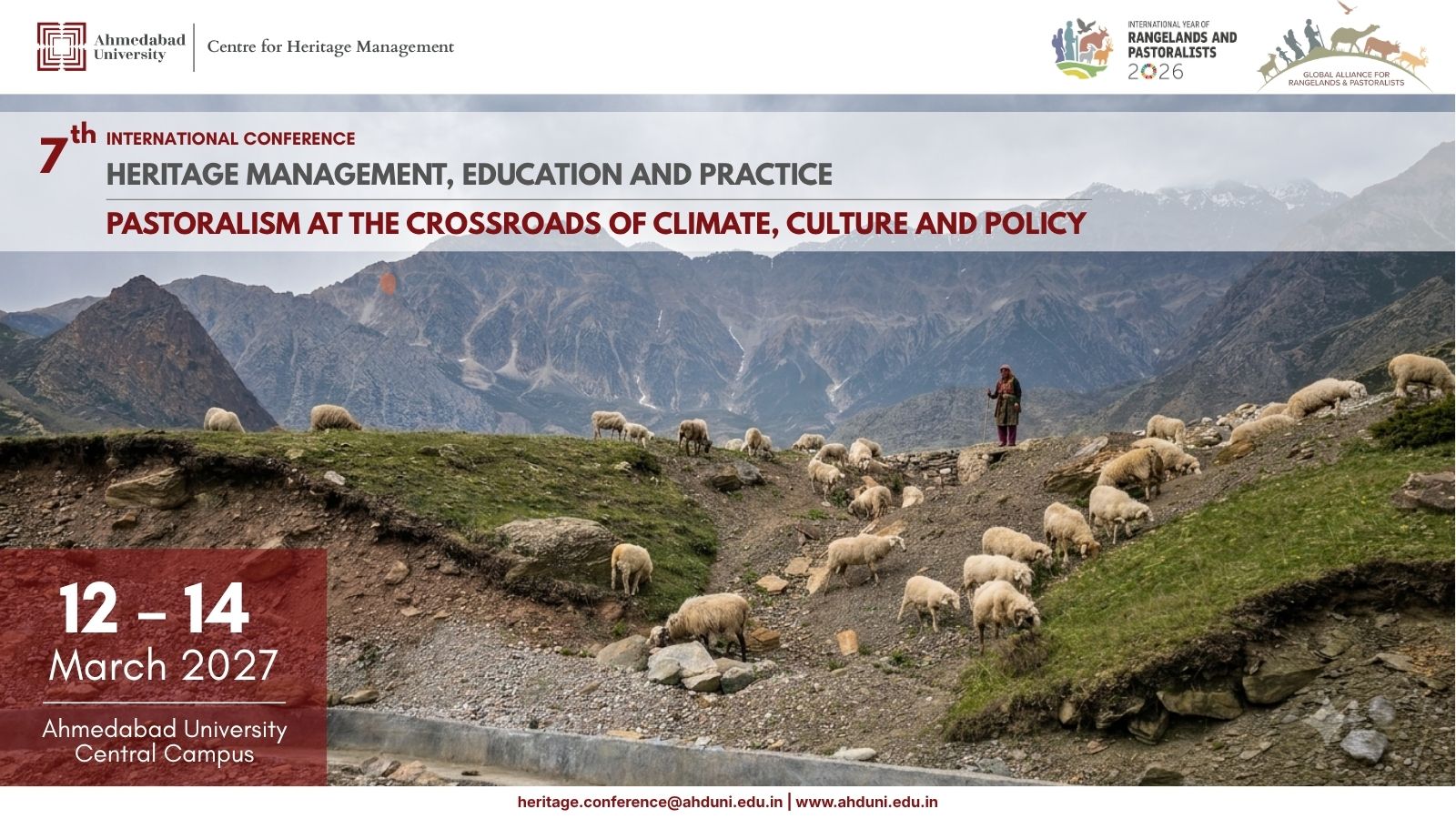

The Centre for Heritage Management at Ahmedabad University announces the seventh edition of its International Conference on Heritage Management Education and Practice. This conference will focus on pastoralism and will be organised on the occasion of the United Nations-declared International Year of Rangelands and Pastoralists (IYRP) 2026, following its completion, to reflect on its initiatives and outcomes and to continue the dialogue on pastoralism issues.
The conference begins with a simple yet important proposition: pastoralism is not a relic of the past. It is a living, adaptive system with deep relevance for the future. In a context of climate instability, ecological degradation, water scarcity, biodiversity loss, and rural livelihood crises, pastoral systems offer practical lessons in sustainability, flexibility, and resilience.
Globally, an estimated 200-500 million people depend directly on pastoralism for their livelihoods. Pastoral communities inhabit drylands, semi-arid regions, high mountains, and other ecologically fragile landscapes across Africa, Asia, Europe, and Latin America. In India alone, more than 40 pastoral communities with a total population ranging from 13 to 20 million people manage livestock across diverse ecological zones. These communities are managers of vast rangelands, custodians of livestock biodiversity, and practitioners of complex ecological knowledge systems.
Pastoral systems contribute directly to global sustainability agendas, including poverty reduction, food security, climate adaptation, biodiversity conservation, and inclusive governance. They offer low-input, adaptive production models that align with Agenda 2030 and the Sustainable Development Goals (SDGs). As climate risks intensify and drylands expand, the key question is not whether pastoralism is viable, but whether policy and governance systems can recognise, support, and learn from its strengths.
This conference builds on the Centre’s previous international conference on climate change, moving from discussions of the global environmental crisis to a focus on community-based adaptive systems. If climate change demands resilience, pastoralism shows how resilience is practised on the ground. Organised on the occasion of the International Year of Rangelands and Pastoralists, following its completion, the conference aims to reflect on IYRP initiatives and outcomes, assess emerging policy directions, and consolidate pathways for future research, documentation, and action, while continuing the dialogue on pastoralism issues.