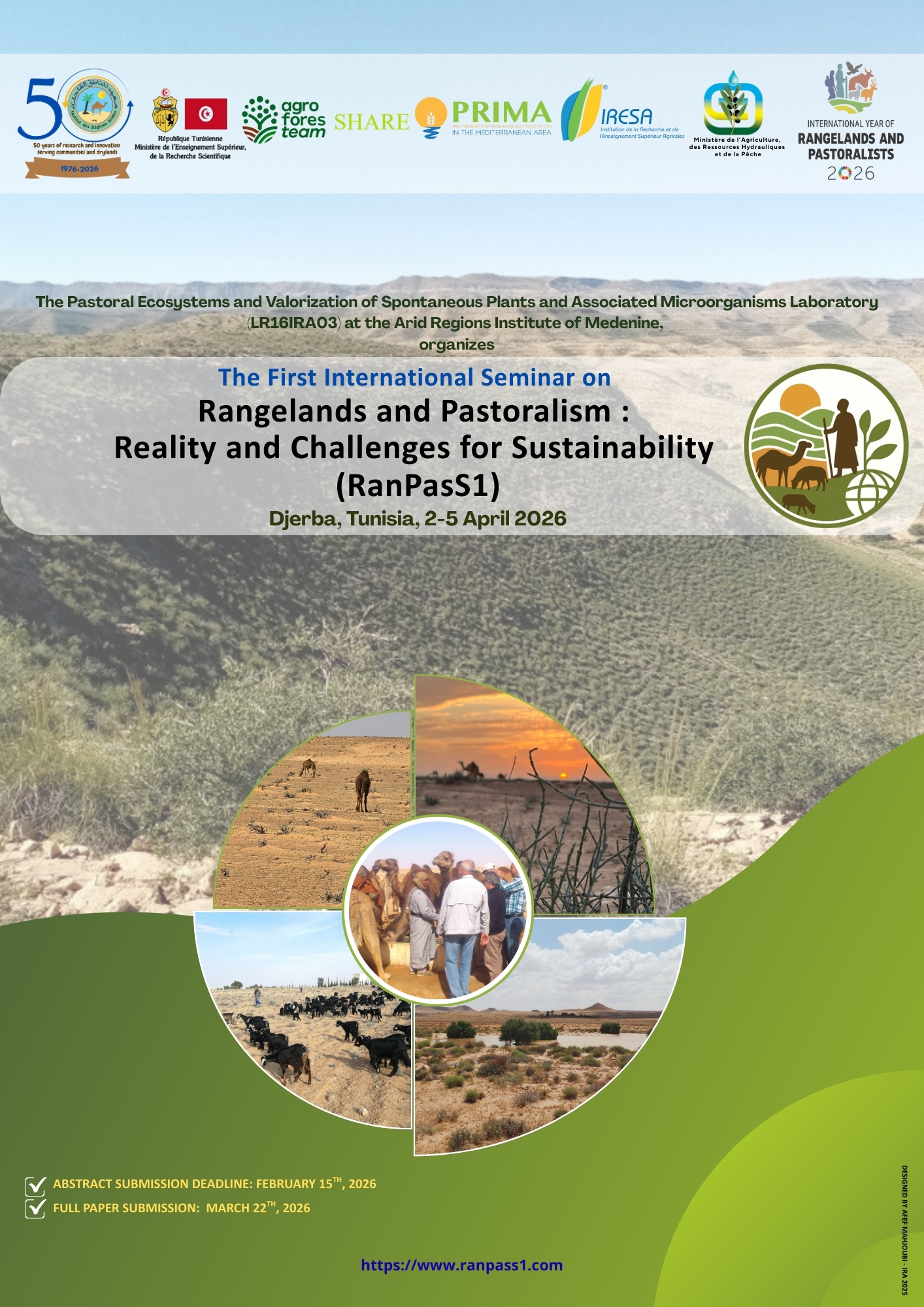

The year 2026 represents both the 50th anniversary of the Arid Regions Institute of Medenine (IRA, Tunisia) and the United Nations (UN) International Year of Rangelands and Pastoralists (IYRP) led by the Food and Agriculture Organization (FAO). Rangelands and pastoralism are linked to diverse ecosystems, cultures, identities, traditional knowledge and historical experience coexisting with nature. Taking into account all this information, the first international seminar on rangelands and pastoralism (RPastS1) will be organized with a special focus on dryland pastoral ecosystems and pastoralists. Drylands cover around 40% of the earth’s surface and contain more than two billion people. These regions are particularly vulnerable to the effects of climate change, desertification and increasing human pressure. Arid rangelands, extensive grazing systems used by pastoral communities, are at the heart of the ecological, economic and cultural dynamics of these areas. Yet they are often overlooked in public policies. Rangelands represent some of the planet’s largest and most crucial ecosystems. They are integral to global environmental balance and play a significant role in supporting nearly 75% of the world’s energy demands. Defined as uncultivated lands that sustain both livestock and wildlife, rangelands encompass a diverse range of ecosystems, including forests, grasslands, wetlands, savannas, steppes, and deserts. In addition to their role in food production and resource supply, rangelands provide a variety of essential ecosystem services including biodiversity conservation, carbon sequestration, and the provision of cultural and recreational spaces, such as those used for tourism and hunting. However, over recent decades, these landscapes have been increasingly subjected to human pressures, often resulting from unsustainable land use practices that threaten their ecological integrity. Climate change further exacerbates these pressures, accelerating the degradation of these already fragile ecosystems. The dynamics of collective rangelands are particularly affected by competition among diverse stakeholders, such as farmers, herders, and local communities, often leading to conflicts over access and resource use. These tensions have driven significant institutional transformations, challenging the resilience and functionality of traditional governance systems.
Support implementation of IYRP 2026!