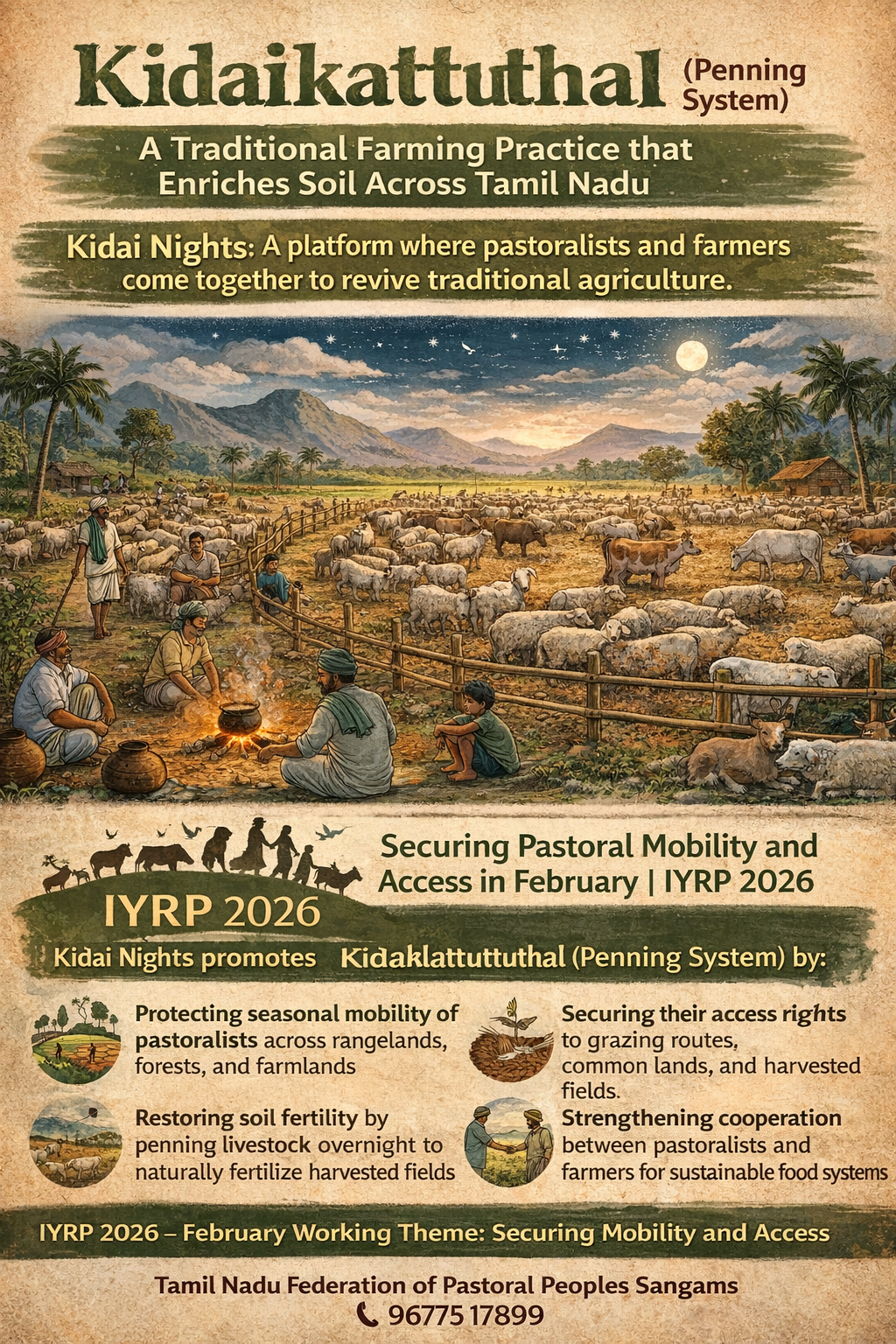
a community-led initiative titled “Kidai Nights”, organised by the Tamil Nadu Federation of Pastoral Peoples Sangams (TFPPS) as part of the International Year of Rangelands and Pastoralists – 2026 (IYRP 2026).
The programme will commence on 1st February 2026 at Karungali Village, Sivagangai District, Tamil Nadu, and will continue over multiple nights across different locations, in alignment with the February IYRP 2026 Working Theme: “Securing Mobility and Access.” The term “Kidai” is the Tamil word for “Penning.” Kidaikattuthal (Penning System) refers to the traditional practice of penning livestock — mainly sheep and cattle — overnight on harvested agricultural fields. This practice is a core pillar of Tamil Nadu’s food production system and has been followed for over 5,000 years as an integral part of the Tamil “Thinai” (eco-cultural landscape) way of life.
Through Kidaikattuthal:
- Soil fertility is restored naturally through animal dung and urine
- Soil organic matter and microbial life are regenerated
- Dependence on chemical fertilisers is reduced
- Agricultural productivity in the following season is strengthened
Seasonal Practice: January–February: In Tamil Nadu, the Tamil month of Thai (January) marks the completion of the harvest season. Traditionally, January and February are the culturally and ecologically appropriate months when Kidaikattuthal (Penning System) is practised across farmlands.
Pastoral Mobility and Food Systems - To practise Kidaikattuthal, pastoral communities undertake seasonal mobility from the Western and Eastern Ghats, dry forest regions, and rangelands to agricultural plains and river basins such as Thamirabarani, Vaigai, and Cauvery. This seasonal movement ensures nutrient cycling between rangelands and farmlands and highlights the indispensable role of pastoralists in sustainable food systems and land regeneration.
Kidai Nights is envisioned as a Pastoral Rights Restoration Dialogue, conducted at actual penning sites during night hours. It brings together:
- Pastoralists
- Farmers
- Indigenous and nature-dependent communities
The programme creates space for dialogue on:
- Securing pastoral mobility and access
- Recognition of traditional grazing and farming rights
- Revival of indigenous ecological knowledge
- Strengthening agro-pastoral cooperation
Support implementation of IYRP 2026!